Postdoctoral Fellow · Harvey Lab · Department of Pharmacology · University of Nevada, Reno School of Medicine
Chase Fiore
Postdoctoral Fellow · Ph.D.
about me
Reno, NevadaPostdoctoral FellowPh.D. 2025
Cardiac pharmacologist and cellular electrophysiologist. I study how the sympathetic nervous system speaks to individual heart muscle cells, why that signaling is compartmentalized down to specific membrane domains, organelles and even the nucleus, and how those conversations change in the diseased heart, where the same signals can trigger life-threatening arrhythmias.
I am a postdoctoral fellow in Robert Harvey’s laboratory in the Department of Pharmacology at the University of Nevada, Reno School of Medicine, where I also earned my Ph.D. in Cellular and Molecular Pharmacology and Physiology. My experiments pair whole-cell patch-clamp recordings with FRET-based biosensor imaging in living myocytes, from adult rat ventricular cells to cells isolated from porcine hearts recovering from myocardial infarction.
research focus
cAMP compartmentation
How β-adrenergic receptors, adenylyl cyclases, phosphodiesterases and A-kinase anchoring proteins shape local cAMP signals in cardiac myocytes, measured with targeted FRET biosensors.
ion channel electrophysiology
Whole-cell voltage clamp of L-type Ca2+ channels in ventricular myocytes and hERG (KV11.1) K+ channels in heterologous cells, including drug block and its dependence on the membrane environment.
autonomic co-transmission
Neuropeptide Y and norepinephrine act on the heart together. I study how their combined effects on Ca2+ current are rewired after myocardial infarction, when NPY levels rise and arrhythmia risk climbs.
receptor crosstalk
Nuclear α1A-adrenergic receptors can restrain β-adrenergic cAMP production through an inside-out MAP kinase pathway, a non-canonical mechanism that may underlie α1A cardioprotection.
principal facts
0
publications & preprints
0
first-author studies
0+
years in cardiac signaling research
0
collaborating institutions
research network
UNR MedHarvey Lab · Pharmacology
UC DavisClancy & Vorobyov labs
UCLACardiac Arrhythmia Center
Chapman UniversitySchool of Pharmacy
resume
Ph.D. 20253 first-author studies7+ years at the bench
Cardiac cellular electrophysiologist with first-author work in JACC: Clinical Electrophysiology and on bioRxiv, trained across patch-clamp electrophysiology, live-cell FRET imaging and molecular biology. I take projects from myocyte isolation through recording, analysis and manuscript, and I enjoy working alongside computational modelers and clinical arrhythmia groups.
skills
Electrophysiology
Whole-cell patch clamp
Voltage clamp of ICa,L
hERG / IKr pharmacology
Ion channel drug block
Cardiac action potential
Imaging & biosensors
FRET-based cAMP biosensors
Live-cell imaging
Confocal microscopy
Fluorescence imaging
Targeted (raft / non-raft) sensors
Cell & molecular biology
Adult ventricular myocyte isolation (rat, pig)
HEK293 heterologous expression
Quantitative RT-PCR
Immunocytochemistry
Subcellular fractionation
Pharmacology & signaling
GPCR signaling (α1-, β-adrenergic, NPY Y1/Y2)
PKA / AKAP compartmentation
Antiarrhythmic drug mechanisms
Membrane cholesterol manipulation
MAPK & GRK/arrestin pathways
Communication
First-author manuscripts
Conference presentations
Figure design & data analysis
Cross-disciplinary collaboration
education
Ph.D. · 2025
University of Nevada, Reno
School of Medicine · Reno, Nevada
Doctor of Philosophy in Cellular and Molecular Pharmacology and Physiology. Doctoral research in the Harvey Lab on adrenergic and neuropeptide regulation of cardiac myocyte signaling and ion channel function.
honors
2024 – 2025
Graduate Dean’s Merit Scholar
The Graduate School · University of Nevada, Reno
University-wide award for master’s and doctoral students with an outstanding academic record and strong promise in their scholarship.
Foundation award
Wiener Biomedical Graduate Scholar
Molecular Biosciences Graduate Program · University of Nevada, Reno
Foundation award presented to members of the Molecular Biosciences Graduate Program engaged in biomedical research.
2022 – 2023
Raymond H. Berner Graduate School Scholarship
The Graduate School · University of Nevada, Reno
Endowed scholarship for graduate students in the molecular biosciences, awarded on nomination by the graduate program director.
experience
2025 – present
Postdoctoral Fellow
Harvey Lab · Department of Pharmacology · UNR Med
Leading studies of how neuropeptide Y and norepinephrine jointly regulate L-type Ca2+ channels in ventricular myocytes from healthy and post-infarction porcine hearts, in collaboration with the UCLA Cardiac Arrhythmia Center.
Doctoral research · to 2025
Ph.D. Candidate
Cellular & Molecular Pharmacology and Physiology · University of Nevada, Reno
Used FRET-based biosensors and patch clamp to uncover an inside-out, nuclear α1A-adrenergic receptor pathway that limits β-adrenergic cAMP production, and showed that membrane cholesterol shapes how antiarrhythmic drugs block hERG K+ channels.
Since 2019
Research Team Member
Harvey Lab · Department of Pharmacology · UNR Med
Co-authored studies on localized cAMP production by β2-adrenoceptors in human airway smooth muscle and on the A-kinase anchoring proteins that tether PKA to mitochondria in ventricular myocytes.
presentations
February 2025
Biophysical Society 69th Annual Meeting
BPS 2025 · Los Angeles, California
Complex effects of neuropeptide Y on Ca2+ channel activity in cardiac ventricular myocytes. Biophysical Journal 124(3):598a.
Robert Harvey’s decades-long journey at UNR Med is marked by discovery, mentorship and leadership in cardiovascular research. By Reilly Moss · May 26, 2026
My mentor, Robert Harvey, Ph.D., professor and chair of pharmacology at the University of Nevada, Reno School of Medicine, has been named a recipient of the 2026 Foundation Professor Award, one of the University’s highest faculty honors. The profile traces his path from a postdoctoral fellow arriving in Reno in 1987, through a landmark Science paper identifying a previously unknown chloride current in the heart, to his current roles leading the Department of Pharmacology and directing the Nevada Center of Biomedical Research Excellence (COBRE) in Molecular and Cellular Signal Transduction in the Cardiovascular System.
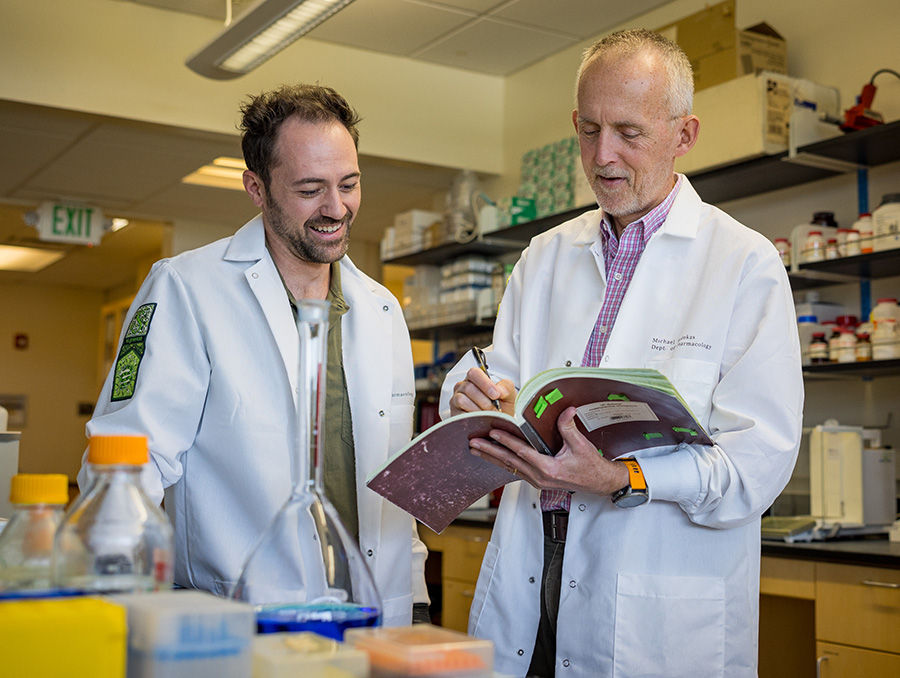
The article features the two of us at the bench, and it lays out the question our lab is built around: why autonomic signaling that is beneficial in a healthy heart can trigger the life-threatening arrhythmias that lead to sudden cardiac death in a diseased one. Sudden cardiac death accounts for nearly half of all deaths from cardiovascular disease and kills more than 350,000 people a year in the United States alone. My work on neuropeptide Y after myocardial infarction and on adrenergic receptor crosstalk sits squarely inside that question.
“Everything I have accomplished in my career has been part of a team effort. Some of the most exciting work I have been associated with was either conducted by or in collaboration with the very talented students, postdoctoral fellows, colleagues and mentors with whom I have had the good fortune to work.”
Robert Harvey, Ph.D., 2026 Foundation Professor, in Nevada Today
Why it matters for my work
Harvey’s program asks how the same sympathetic signals can protect a healthy heart yet destabilize a diseased one. Every project on this site, from nuclear α1A-adrenergic crosstalk to neuropeptide Y after infarction, is a piece of that puzzle.
I am glad to hear from prospective collaborators, students interested in cardiac electrophysiology and signaling, and anyone curious about the work. The quickest ways to reach me are LinkedIn and ResearchGate.